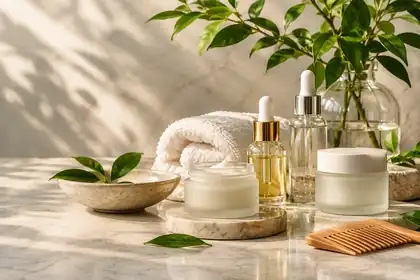
The morning minimum.
A practical foundation for days when you want to keep your routine short and consistent.
Build a routine around real concerns, useful habits and products you understand. Explore practical guides for skin, scalp and hair — then keep only the steps that work for your everyday life.
Plan · Care · Glow / 001
Select the area closest to your question. This is an educational starting point, not a diagnosis tool; it helps you choose what to read next.
Tap one area to reveal practical observations and relevant reading.
Start by describing the pattern instead of reaching for a stronger product. Skin concerns can overlap, and the next step depends on how long it has been happening and what else has changed.
Stinging, tightness or flaking after a wash can be a reason to review cleansing and active ingredients.
Keep a gentle cleanser, a comfortable moisturiser and daytime sun protection as routine anchors.
Persistent pain, swelling, scarring or a new changing pigmented spot deserves qualified assessment.
Think in repeatable sequences, not product piles. These are general examples to adapt to your needs and product labels.
Choose comfortable basics, keep tools within reach, and build a small ritual you can repeat on busy mornings and slower evenings alike.
A practical foundation for days when you want to keep your routine short and consistent.
When several products have entered the routine, make it easier to identify what your skin is responding to.
Scalp comfort and the condition of the hair shaft are related, but they are not the same issue.
Flakes, shedding, itch and breakage can arise for different reasons. Match the observation to the relevant guide before treating every problem as a shampoo problem.
Consider dryness, dandruff, irritation or another scalp condition. Persistent redness, soreness or thick scale needs assessment.
Anti-dandruff example ↗Record the start date, pattern and scalp symptoms. Sudden, patchy or ongoing loss should be checked professionally.
Hair fall shampoo example ↗Look at heat, friction, chemical processing and detangling habits. A serum can improve feel without reversing damage.
Smoothing serum example ↗Hair growth claims need context. Cosmetic products should not replace assessment of the cause of hair loss.
Growth serum listing ↗Ingredients are not interchangeable. The complete formula, its directions and your tolerance are more useful than a trending percentage or a bold front-label claim.
A form of vitamin B3 used in topical skincare formulas.
May support barrier function and the appearance of uneven tone; the whole formula matters.
Serum example ↗A humectant used to attract and hold water in a formula.
Texture, base formula and the moisturiser used alongside it affect the experience.
Serum example ↗A topical retinoid in the vitamin A family.
Can irritate; introduction and frequency matter. Follow label guidance and seek advice for individual circumstances.
Serum example ↗A broad group of ingredients used to loosen surface cell connections.
Strength, pH and frequency vary. Professional peels are not equivalent to everyday home exfoliation.
Peel category ↗Use this on-page checklist to focus on habits you want to repeat this week. Your selections stay in this page only and are not sent anywhere.
Choose a few routine anchors, keep new products separate, and make a note if irritation or an unexpected change appears. This is a simple checklist, not a medical tracker.
Useful rule: do not introduce several new actives at the same time. Consistency makes it easier to identify what suits you.
These links lead to Cosmetics Compounding's educational hubs, library, collections and product pages. They are included when they relate to a point in this guide, not as individual product recommendations.
Visit Cosmetics Compounding ↗